Names are being preserved deliberately.
Titles that once appeared across scattered blog traces are now readable together as part of one body of work.
Works catalog
It gathers titles, year markers, media notes, place links, and restoration threads into one readable index. Some entries remain brief because the surviving public record is brief, but keeping them visible is still valuable.
Catalog overview
This page helps visitors move from titles to patterns: place, medium, date, and connected research threads. It is meant to be useful first and expandable over time.
Titles that once appeared across scattered blog traces are now readable together as part of one body of work.
Watercolor, acrylic, foil collage, colored pencil, design, and restoration-era color work all remain visible together.
Timeline, places, archaeology, gallery, and source pages work together instead of reading as disconnected tabs.
What this catalog does
Current scope
Faster art discovery
The artwork guide gives readers a fast route into Southwest imagery, ancient-world restoration, symbolic pieces, and Tucson-era studio traces before they come back here for titles and year markers.
Best pairing
That pairing is especially useful when someone remembers a place, subject, or visual mood but not the exact title.
Find a work by what you remember
Use these routes before dropping back into the catalog when you do not have an exact title yet.
Use the places guide when the memory is Tucson, Four Peaks, Monument Valley, Taos, Limoux, or another recurring location.
Browse placesUse the artwork guide when the entry point is Southwest landscape, sacred image, ancient-world restoration, or symbolic reading.
Browse the artwork guideUse the gallery when the quickest way in is visual browsing before you come back for titles, dates, and related pages.
Open the galleryUse the downloads page when you want the clearest route to larger public files and shareable artwork entry points.
Open free downloadsSource-grounded caption starters
These are short caption-style notes built only from details already preserved publicly: title, year marker, medium, place, or the outside source trail that keeps the work identifiable.
Caption starter: 1973 acrylic. A Southwest mountain title that moves the early archive from landscape into visionary image-making without losing its place-based ground.
Caption starter: 1975 acrylic designs tied to Tucson. One of the clearest signs that public-facing design work belonged inside the same body of work as the paintings.
Caption starter: 1977 foil collage. A named sacred-image work that gives the symbolic and resurrection strand a clear title, date marker, and medium.
Caption starter: 1982. Preserved through the July 26, 2008 T.S. Steve Minton post, making it one of the clearest named-work anchors in the outside Tucson / MJA Studio trail.
Caption starter: MJA Studio 1986 reconstruction work tied to Izapa. One of the strongest public archaeology-art anchors because the site, date line, and studio credit all survive visibly.
Caption starter: MJA Studio 1995, described publicly as handcut transparent acetate. A strong later Southwest anchor because it preserves place, studio identity, date, and medium-like material detail together.
Known works
Grouped by strong public patterns rather than strict medium alone.
Publicly preserved as a 1966 and 1973 work described as acrylic over oil. It sits early in the visible timeline and shows how the archive sometimes preserves multiple year markers for the same title.
Two 1971 watercolor works preserved together in the early CalleValentinus grouping, showing a strong visionary and interior-image thread.
A 1971 acrylic preserved in the public archive trail and important to both the visual catalog and the places map.
A 1972 watercolor that helps anchor the Four Peaks thread. The work stands at the intersection of portrait, place, and mythic naming.
A 1973 acrylic that extends the Southwest mountain imagery into a more symbolic and visionary register.
Preserved publicly as 1975 acrylic designs tied to Tucson. These are especially useful because they point toward public-facing applied work as well as studio art.
Related page: kept visible through the 2018 art-blog cluster and now linked more directly to the Tucson / MJA Studio page.
A 1977 art-foil collage that strengthens the sacred and symbolic strand in the catalog.
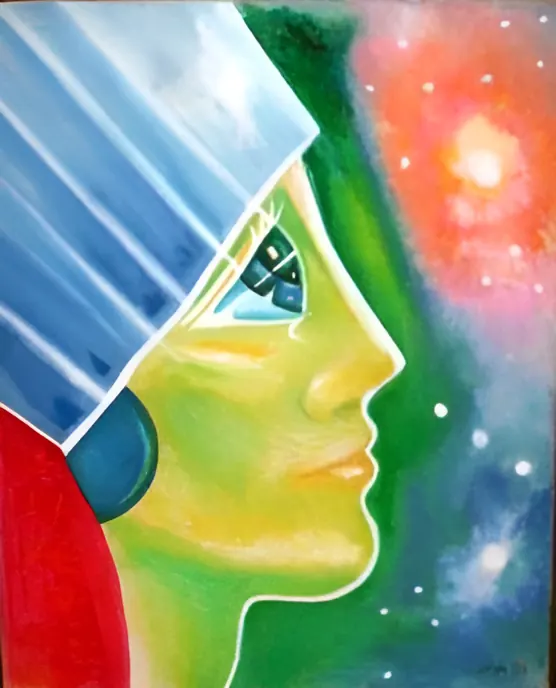
The 1980 acrylic preserved in the public record links astronomy, figure, and symbol in a way that broadens the archive beyond landscape alone.
These 1981–1982 works form a concentrated Four Peaks and prophetic-image cluster, with acrylic and foil-collage modes both present.
Two 1982 works preserved across different sources. Taos Profile on Redwood is described as metallic acrylic on raw redwood, while Phoenix Bird survives through the 2008 T.S. Steve Minton post.
Related page: Phoenix Bird is one of the clearest outside anchors in the catalog and now connects directly to Tucson & MJA Studio.
The catalog includes restoration-oriented MJA / MJA Studio work preserved as 1986-era color and reconstruction pieces, plus later-presented Nimrud material. These entries are essential to understanding the research and archaeological side of the archive, and they now connect to a dedicated archaeology-and-restoration page.
Related pages: use Izapa restoration and Archaeology & Restoration for the stronger outside-credit and reconstruction trail.
Preserved in the public record as MJA Studio 1995, described as handcut transparent acetate. This entry helps bridge the Southwest place story with the studio-era catalog.
Related page: this 1995 MJA Studio marker helps bridge the Southwest art trail to the later Tucson / MJA Studio page.
A 1999 work preserved as an art-foil collage. It marks a late Southwest fire-and-mountain entry in the public sequence.
The St. George pair shows both finished-image and study logic in the archive, with the public record preserving 2002 year markers.
The zoo sequence is visible through a 2003 painting reference and a 2005 close-up study, preserving a relationship between larger work and extracted detail.
These later works, preserved with 2003 and 2004 markers, show the archive holding onto smaller named pieces that might otherwise vanish from memory.
A 2005 colored-pencil design preserved publicly, showing that the catalog also needs room for commissioned or applied-image work.
Move between this index, the timeline, the places page, the gallery, and the source library. Each page answers a different archive question.
The catalog is not complete, but it already makes the visible work easier to find, name, and connect.
MJA Life